
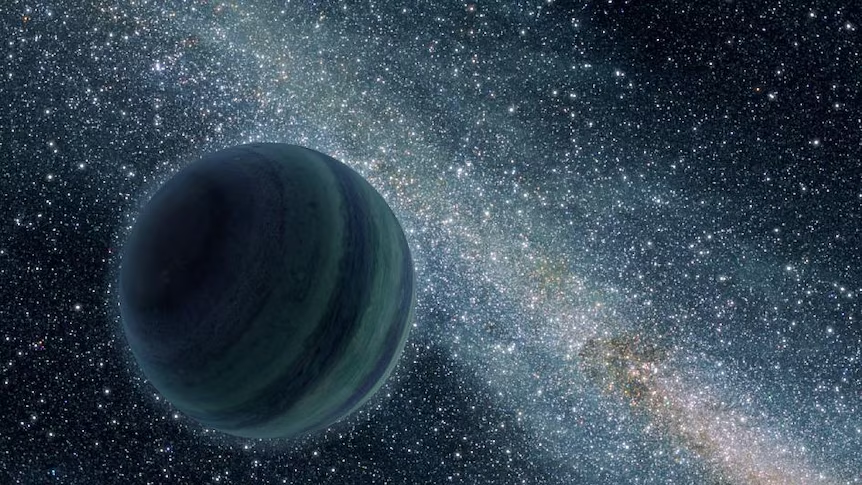
What Are Rogue Planets?
Imagine a planet drifting through the vast, cold darkness of space, untethered to any star. These are rogue planets, also called free-floating planets, wandering the galaxy without a parent star to orbit. Unlike Earth, which basks in the Sun’s warmth, these celestial nomads rely on other mechanisms to sustain conditions that might support life. Scientists estimate there could be billions, possibly trillions, of these planets in the Milky Way alone, potentially outnumbering stars.
How Do Rogue Planets Form?
Rogue planets come into existence through fascinating cosmic processes. Some are ejected from their home star systems due to gravitational tussles with larger planets, while others may form directly from collapsing clouds of gas and dust, much like stars. I remember reading about these cosmic castaways and feeling a mix of awe and curiosity—how does a planet just “go rogue”? It’s like a rebellious teenager storming out of the solar system, but on a galactic scale.
Ejection from Star Systems
During the chaotic early years of a star system, gravitational interactions can fling planets out into interstellar space. Imagine a cosmic game of billiards, where a massive gas giant nudges a smaller planet out of orbit. Simulations suggest this happens frequently, especially in crowded systems. These ejected planets often take their moons along for the ride, setting the stage for intriguing possibilities.
Formation in Interstellar Space
Some rogue planets form independently, condensing from gas and dust clouds without ever orbiting a star. This process mirrors star formation but on a smaller scale. Picture a lonely cloud in space, slowly collapsing under its own gravity to birth a planet instead of a star. It’s a reminder of how diverse the universe’s creation stories can be.
Can Moons of Rogue Planets Support Life?
The idea that life could exist on a moon orbiting a rogue planet sounds like science fiction, but recent research suggests it’s plausible. These moons, warmed by tidal heating and insulated by thick atmospheres, could harbor liquid water—a key ingredient for life as we know it. The notion of life thriving in the galaxy’s darkest corners is both thrilling and humbling, like finding an oasis in a desert.
The Role of Tidal Heating
Tidal heating occurs when a moon’s orbit around its planet isn’t perfectly circular, causing gravitational forces to stretch and compress the moon’s interior. This friction generates heat, much like rubbing your hands together on a cold day. In our solar system, moons like Europa and Enceladus rely on this process to maintain subsurface oceans, and the same could apply to moons of rogue planets.
Importance of Atmospheres
A thick, heat-trapping atmosphere is crucial for these moons to retain warmth. Think of it as a cozy blanket keeping the moon’s surface or subsurface water liquid. Research suggests atmospheres rich in carbon dioxide or hydrogen could sustain habitable conditions for hundreds of millions, even billions, of years, giving life a chance to emerge.
Conditions for Habitability
For a moon to be habitable, it needs more than just liquid water. It requires stability, energy sources, and the right chemical ingredients. Moons of rogue planets face unique challenges, but their isolation from stars might actually offer some advantages. I once heard an astrobiologist joke that these moons are like cosmic introverts—thriving in solitude, away from the chaos of stellar flares.
Liquid Water and Stability
Liquid water is the cornerstone of life as we know it. On rogue planet moons, water could form through chemical reactions between atmospheric carbon dioxide and hydrogen, triggered by cosmic rays. Simulations show that with the right orbit and atmosphere, these moons could maintain liquid water for up to 1.6 billion years—plenty of time for life to take hold.
Energy Sources Beyond Sunlight
Without a star, these moons rely on internal heat from tidal forces or radioactive decay. In our solar system, Enceladus’ hydrothermal vents, powered by tidal heating, support microbial life in Earth-like environments. Similar vents on rogue planet moons could provide energy for life, proving that sunlight isn’t the only game in town.
Protection from Cosmic Radiation
No star means no solar flares, which can strip atmospheres from planets and moons. The thick icy crusts of these moons act like shields, protecting potential life forms from cosmic radiation and asteroid impacts. It’s like living in a fortified bunker, safe from the galaxy’s dangers.
Comparing Rogue Planet Moons to Solar System Moons
To understand the potential of rogue planet moons, let’s compare them to some familiar moons in our solar system. Europa, Enceladus, and Titan offer clues about how life might persist in extreme environments, and their lessons apply to these starless worlds.
| Moon | Parent Planet | Heat Source | Water Source | Habitability Potential |
|---|---|---|---|---|
| Europa | Jupiter | Tidal heating | Subsurface ocean | High, with possible hydrothermal vents |
| Enceladus | Saturn | Tidal heating | Subsurface ocean, plumes | High, with organic molecules detected |
| Titan | Saturn | Minimal tidal heating | Surface methane lakes | Moderate, possible exotic life |
| Rogue Planet Moon | None (rogue planet) | Tidal heating | Subsurface or surface water | High, with thick atmosphere |
Lessons from Europa
Europa’s subsurface ocean, kept liquid by Jupiter’s gravitational pull, is a prime candidate for life. Rogue planet moons could mirror this setup, with tidal heating creating warm, watery environments beneath icy crusts. It’s like Europa, but without the stellar spotlight.
Lessons from Enceladus
Enceladus stunned scientists with its geysers, spewing water and organic molecules from a subsurface ocean. Rogue planet moons with similar setups could harbor microbial life, especially if their oceans host hydrothermal vents. The idea of life thriving in such dark, distant places feels like a cosmic treasure hunt.
Lessons from Titan
Titan’s thick atmosphere and surface lakes of methane suggest life could adapt to exotic conditions. While rogue planet moons likely rely on water, Titan shows that dense atmospheres can create stable environments, a key factor for habitability. It’s a reminder that life might not always look like Earth’s.
Pros and Cons of Life on Rogue Planet Moons
Pros
- No Stellar Flares: Unlike planets orbiting stars, these moons are safe from atmosphere-stripping solar flares.
- Long-Term Stability: Simulations suggest habitable conditions could last over a billion years, giving life time to evolve.
- Protected Environments: Thick icy crusts shield against cosmic radiation and impacts.
- Tidal Heating: Provides a reliable energy source independent of sunlight.
Cons
- Limited Energy: Without sunlight, energy sources are restricted to internal heating, which may not suffice for complex life.
- Detection Challenges: Rogue planets and their moons are hard to spot, complicating study efforts.
- Atmospheric Requirements: A thick, specific atmosphere is needed to trap heat, which may not always be present.
- Unknown Chemistry: The exact chemical processes for life’s origin in these environments remain speculative.
Challenges in Detecting Rogue Planet Moons
Finding these cosmic wanderers is no easy feat. Without a star’s light to illuminate them, rogue planets and their moons are nearly invisible. I recall watching a documentary where astronomers likened this to finding a needle in a haystack—except the haystack is the entire galaxy, and the needle doesn’t glow.
Gravitational Microlensing
The primary method for detecting rogue planets is gravitational microlensing, where a planet’s gravity bends light from a distant star, briefly magnifying it. This technique has revealed about 100 rogue planets, but confirming their moons is trickier due to their smaller size and faint signals.
Future Telescopes
Next-generation telescopes like the Nancy Grace Roman Space Telescope and the James Webb Space Telescope (JWST) could spot these moons by detecting subtle light changes as they transit their planets. The prospect of glimpsing a real-life Pandora, like in the Avatar movies, keeps astronomers hopeful.
People Also Ask (PAA)
Can planets without stars have habitable moons?
Yes, moons of rogue planets can be habitable if they have thick atmospheres and tidal heating to maintain liquid water. Simulations suggest these conditions could last for over a billion years, providing ample time for life to emerge.
How do rogue planets stay warm without a star?
Rogue planets and their moons stay warm through tidal heating, where gravitational interactions generate internal heat, and radioactive decay within the planet’s core. Thick atmospheres help trap this heat, creating stable conditions.
Are there any confirmed rogue planets with moons?
No confirmed rogue planet moons exist yet, but simulations show that many rogue planets retain their moons after ejection. Future telescopes may detect these moons, offering clues about their habitability.
Could humans live on a rogue planet’s moon?
Human survival would be challenging due to extreme cold, lack of sunlight, and limited resources. However, with advanced technology, such as enclosed habitats, it’s theoretically possible, though far from practical today.
Tools and Resources for Exploring Rogue Planets
For those eager to dive deeper, several tools and resources can enhance your understanding of rogue planets and their moons. These range from accessible apps to professional-grade software used by astronomers.
Best Tools for Amateur Astronomers
- Stellarium: A free, open-source planetarium software that simulates the night sky, helping you visualize rogue planet trajectories. Download Stellarium.
- SkySafari: A mobile app for exploring celestial objects, including exoplanets, with a user-friendly interface. Available on iOS and Android.
- NASA Exoplanet Archive: A database of confirmed exoplanets, including rogue planet candidates, perfect for research. Visit NASA Exoplanet Archive.
Where to Get Professional Insights
- arXiv.org: Access peer-reviewed papers on rogue planets and exomoons for free. Explore arXiv.
- Planetary Society: Offers articles and webinars on rogue planets and habitability. Join the Planetary Society.
- ESO (European Southern Observatory): Provides updates on exoplanet research, including rogue planets. Visit ESO.
The Future of Rogue Planet Research
The search for life on rogue planet moons is just beginning. Upcoming missions and telescopes promise to unlock new insights, potentially confirming the existence of these elusive worlds. I can’t help but feel a spark of excitement imagining what we might discover—a microbial ecosystem, or perhaps something more complex, thriving in the galaxy’s shadows.
Upcoming Missions
The Nancy Grace Roman Space Telescope, set to launch in 2027, will use gravitational microlensing to detect up to 400 Earth-mass rogue planets, potentially revealing their moons. The JWST, already operational, is scanning nearby star systems for clues about exomoons, which could inform rogue planet studies.
Implications for Astrobiology
Discovering life on a rogue planet’s moon would rewrite our understanding of habitability. It would suggest that life doesn’t need a star, expanding the cosmic real estate where we might find it. This possibility keeps me up at night, wondering if we’re on the cusp of a galactic paradigm shift.
FAQ
What makes a rogue planet’s moon habitable?
A habitable moon needs liquid water, sustained by tidal heating or radioactive decay, a thick atmosphere to trap heat, and protection from cosmic radiation. These conditions could support microbial life for billions of years.
How common are rogue planets?
Estimates suggest there could be billions to trillions of rogue planets in the Milky Way, potentially outnumbering stars. Their abundance makes them key targets in the search for extraterrestrial life.
Can we visit a rogue planet’s moon?
Visiting a rogue planet’s moon is currently beyond our technological reach due to their distance and lack of stellar landmarks for navigation. Future advancements in interstellar travel might make it feasible.
How do scientists detect rogue planets?
Scientists use gravitational microlensing, where a planet’s gravity bends light from a distant star, to detect rogue planets. Future telescopes like the Nancy Grace Roman will enhance these efforts.
Could rogue planet moons support complex life?
While microbial life is more likely, complex life could be possible if energy sources and chemical complexity are sufficient. However, the absence of sunlight might limit evolutionary pathways.
Conclusion
Rogue planets and their moons challenge everything we thought we knew about where life can exist. These starless worlds, warmed by tidal forces and shielded by icy crusts, could be cosmic cradles for life, thriving in the galaxy’s darkest corners. As telescopes like the JWST and Nancy Grace Roman peer deeper into space, we may soon uncover evidence of these hidden oases. For now, the idea of life on a rogue planet’s moon sparks wonder and curiosity, reminding us that the universe is full of surprises waiting to be explored.