
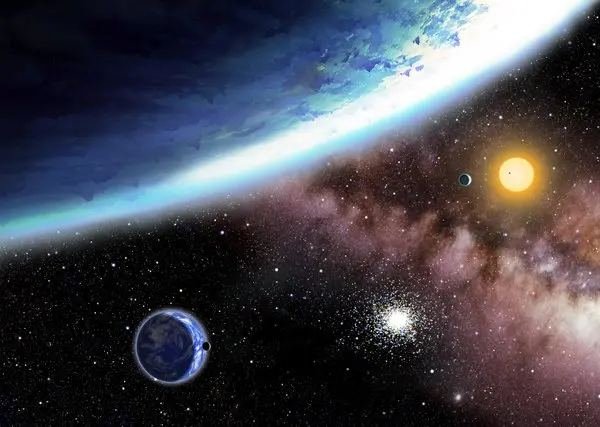
The Thrill of Discovering a New World
Imagine standing under a starry night sky, gazing at the heavens, and realizing that just 4 light-years away, a planet the size of Saturn might be circling a star much like our Sun. The James Webb Space Telescope (JWST) has recently unveiled evidence of such a cosmic neighbor in the Alpha Centauri system, our closest stellar system. This discovery isn’t just a blip on a scientist’s radar—it’s a monumental leap in our quest to understand the universe and our place in it. Let’s dive into this exciting find, exploring what it means, why it matters, and how it reshapes our view of the cosmos.
What Is the Alpha Centauri System?
The Alpha Centauri system, located just 4.37 light-years from Earth, is the closest star system to our Solar System. It’s a trio of stars: Alpha Centauri A, a Sun-like star; Alpha Centauri B, slightly smaller and cooler; and Proxima Centauri, a faint red dwarf. This system has long been a tantalizing target for astronomers hunting for exoplanets—worlds beyond our Solar System. Finding a planet here feels like discovering a new neighbor in your cosmic backyard.
Why Alpha Centauri Matters
Alpha Centauri’s proximity makes it a prime candidate for studying exoplanets up close. Its stars, especially Alpha Centauri A, are similar to our Sun, raising hopes of finding Earth-like planets. However, the system’s complexity, with three stars gravitationally bound, makes planet detection tricky. The recent discovery of a Saturn-sized planet orbiting Alpha Centauri A is a game-changer, offering a rare chance to study a massive world so close to home.
The Discovery: A Saturn-Sized Gas Giant
In August 2024, astronomers using JWST’s Mid-Infrared Instrument (MIRI) detected strong evidence of a gas giant, roughly the size and mass of Saturn, orbiting Alpha Centauri A. This planet, if confirmed, orbits at about twice the distance from its star as Earth does from the Sun, placing it in the habitable zone where liquid water could theoretically exist. However, as a gas giant, it’s unlikely to host life as we know it. The find is still thrilling, as it challenges our understanding of how planets form in multi-star systems.
How JWST Made It Possible
The JWST’s advanced technology, particularly its coronagraphic mask, allowed scientists to block the blinding glare of Alpha Centauri A and reveal a faint object 10,000 times dimmer. This candidate planet appeared in mid-infrared observations, but follow-up images in February and April 2025 didn’t detect it, suggesting it may have moved too close to the star in its elliptical orbit. This cosmic hide-and-seek game highlights the challenges of observing planets in bright, dynamic star systems.
Why This Planet Is a Big Deal
This discovery is monumental for several reasons. It’s potentially the closest exoplanet to Earth orbiting a Sun-like star, making it a prime target for future studies. Its existence in a triple-star system also raises questions about planetary formation in chaotic environments. As Aniket Sanghi, a Caltech graduate student involved in the study, noted, “Its very existence would challenge our understanding of how planets form, survive, and evolve.”
Comparing Our Saturn to the Alpha Centauri Candidate
To grasp the significance of this discovery, let’s compare the candidate planet to Saturn, our Solar System’s iconic gas giant.
| Feature | Saturn (Our Solar System) | Alpha Centauri A Candidate |
|---|---|---|
| Size | Approximately Saturn-sized | |
| Mass | 95 times Earth’s mass | Likely similar to Saturn’s mass |
| Orbit | 9.58 AU from the Sun (1.43 billion km) | ~1–2 AU from Alpha Centauri A |
| Orbital Period | 29.4 Earth years | Unknown, likely shorter due to closer orbit |
| Composition | Hydrogen, helium, rocky core | Likely hydrogen, helium, gas giant structure |
| Rings | Extensive, iconic ring system | Unknown, no evidence of rings yet |
| Habitability | Not habitable, gas giant | Not habitable, gas giant |
Key Similarities
Both planets are gas giants, likely composed of hydrogen and helium with rocky cores. Their sizes are comparable, making the Alpha Centauri candidate a familiar yet distant cousin to Saturn. Both orbit stars, but the candidate’s proximity to Alpha Centauri A places it in a more dynamic environment than Saturn’s stable orbit around our Sun.
Key Differences
Saturn’s famous rings set it apart, as no ring system has been detected around the candidate planet. Saturn orbits much farther from the Sun (9.58 AU) than the candidate does from Alpha Centauri A (1–2 AU), suggesting a tighter, possibly more elliptical orbit. This closer orbit could mean a shorter orbital period, though exact details are still under study.
The Science Behind the Discovery
Detecting a planet in the Alpha Centauri system is no small feat. The brightness of Alpha Centauri A and B, combined with their rapid movement across the sky, makes imaging planets incredibly challenging. The JWST team, led by researchers like Charles Beichman and Aniket Sanghi, used advanced techniques to overcome these hurdles.
The Role of the Coronagraphic Mask
The coronagraphic mask on JWST’s MIRI instrument blocks starlight, allowing fainter objects like planets to become visible. This technology is like putting sunglasses on a telescope to peer through a star’s glare. By carefully subtracting the light from both Alpha Centauri A and B, the team revealed a faint signal consistent with a Saturn-sized planet.
Challenges in Confirmation
The planet’s elliptical orbit complicates confirmation. Computer simulations suggest it may have been too close to Alpha Centauri A during later observations, explaining why it vanished from view. Future observations with JWST or the upcoming Nancy Grace Roman Space Telescope (set to launch by May 2027) could provide clarity.
Implications for Planetary Formation
The candidate planet’s presence in a triple-star system challenges existing models of planetary formation. Multi-star systems are chaotic, with gravitational tugs from multiple stars making stable orbits difficult. If confirmed, this planet suggests that gas giants can form and survive in such environments, prompting scientists to rethink how planets coalesce around stars.
Why This Planet Can’t Support Life
Despite orbiting in Alpha Centauri A’s habitable zone, this gas giant is unlikely to host life as we know it. Here’s why:
- Gas Giant Composition: Like Saturn, it’s primarily hydrogen and helium, lacking a solid surface for life to take root.
- Elliptical Orbit: Its orbit sweeps through the habitable zone, creating extreme temperature swings that destabilize conditions for life.
- No Rocky Companions: The planet’s massive gravity and elliptical path likely prevent smaller, rocky planets from forming or surviving in the habitable zone.
Could Moons Be Habitable?
Saturn’s moons, like Titan and Enceladus, hint at the possibility of habitable moons around gas giants. Titan has a thick atmosphere and liquid methane lakes, while Enceladus boasts subsurface oceans. If the Alpha Centauri planet has moons, they could theoretically harbor conditions for life, though no evidence of moons has been detected yet.
The Broader Impact of This Discovery
This find isn’t just about one planet—it’s a stepping stone to understanding our cosmic neighborhood. Here are some broader implications:
- Future Observations: The proximity of Alpha Centauri makes it ideal for detailed studies with future telescopes, potentially revealing more about the planet’s atmosphere or moons.
- Planetary Formation Theories: The planet’s existence challenges models of how planets form in multi-star systems, pushing scientists to refine their theories.
- Inspiration for Exploration: Discoveries like this fuel public interest in space exploration, encouraging investment in missions to study exoplanets up close.
A Personal Reflection
As a lifelong stargazer, I remember peering through a small telescope as a kid, marveling at Saturn’s rings. The idea that a similar world might exist just 4 light-years away feels like a cosmic wink—a reminder of how vast yet connected our universe is. This discovery makes me wonder: what other surprises are hiding in our stellar neighborhood?
Pros and Cons of Studying This Planet
Pros
- Proximity: At 4 light-years, it’s the closest known exoplanet orbiting a Sun-like star, ideal for detailed study.
- Scientific Value: It challenges planetary formation theories, offering insights into multi-star systems.
- Technological Feat: Demonstrates JWST’s power to image faint objects, paving the way for future discoveries.
Cons
- Confirmation Challenges: The planet’s elliptical orbit makes it hard to observe consistently.
- Limited Habitability: As a gas giant, it’s not a candidate for life, limiting its appeal for astrobiology.
- Resource Intensity: Studying such faint objects requires significant telescope time and computational power.
People Also Ask (PAA) Section
What is the closest exoplanet to Earth?
The closest confirmed exoplanet is Proxima b, orbiting Proxima Centauri, 4.24 light-years away. It’s a rocky, Earth-sized planet in the habitable zone, discovered in 2016. The Saturn-sized candidate around Alpha Centauri A, if confirmed, would be the closest exoplanet orbiting a Sun-like star.
Can we visit Alpha Centauri?
Visiting Alpha Centauri is currently beyond our technological reach. At 4.37 light-years, even the fastest spacecraft would take thousands of years to arrive. Projects like Breakthrough Starshot aim to send tiny probes at 20% the speed of light, but such missions are still decades away.
How does JWST detect exoplanets?
JWST uses instruments like MIRI with coronagraphic masks to block starlight, revealing fainter planets. It detects infrared light, ideal for spotting gas giants or warm planets. Techniques like transit photometry and direct imaging help confirm exoplanet candidates.
Are there habitable planets in Alpha Centauri?
No confirmed habitable planets exist in Alpha Centauri. The Saturn-sized candidate in the habitable zone is a gas giant, unsuitable for life. Proxima b, in the same system, is a better candidate, but its habitability is uncertain due to stellar flares.
Tools and Resources for Learning More
Best Tools for Astronomy Enthusiasts
- Stellarium: A free, open-source planetarium software to explore the Alpha Centauri system and simulate its skies.
- NASA Exoplanet Archive: A comprehensive database of confirmed exoplanets, including data on Alpha Centauri candidates.
- SkySafari: A mobile app for real-time star maps, perfect for locating Alpha Centauri in the night sky.
Where to Get More Information
- NASA’s Science Website: Offers detailed articles and updates on JWST discoveries.
- Caltech’s Research Impact Page: Provides in-depth insights from the team behind the Alpha Centauri discovery.
- The Astrophysical Journal Letters: Access the original research papers for technical details (available via arXiv).
FAQ Section
Q: Is the Saturn-sized planet confirmed?
A: Not yet. The JWST detected strong evidence, but follow-up observations are needed due to the planet’s elliptical orbit. Future telescopes like the Nancy Grace Roman Space Telescope may confirm it.
Q: Why can’t this planet support life?
A: As a gas giant, it lacks a solid surface and has extreme conditions unsuitable for life as we know it. Its elliptical orbit also creates unstable temperatures.
Q: How far is Alpha Centauri from Earth?
A: Alpha Centauri is 4.37 light-years away, or about 41 trillion kilometers. It’s the closest star system to our Solar System.
Q: Can I see Alpha Centauri with a telescope?
A: Yes, Alpha Centauri is visible with the naked eye in the Southern Hemisphere and through small telescopes elsewhere. A backyard telescope can reveal its binary stars, but planets require advanced instruments like JWST.
Q: What’s next for studying this planet?
A: Astronomers will use JWST and future telescopes to confirm the planet’s orbit, size, and composition. Long-term studies may also search for moons or additional planets in the system.
Looking Ahead: What This Means for the Future
This discovery is a cosmic milestone, but it’s just the beginning. The Alpha Centauri system, with its Saturn-sized candidate, offers a unique laboratory to study planetary systems up close. Future missions, like the Nancy Grace Roman Space Telescope, could reveal more details, while advancements in imaging might one day let us see this planet’s atmosphere or moons. For now, it’s a reminder of how much we still have to learn about our universe—and how exciting that journey will be.
A Final Thought
Picture yourself under the night sky, knowing a Saturn-like world might be orbiting just 4 light-years away. It’s a humbling thought, connecting us to the vastness of space. As we continue to explore, discoveries like this remind us that the universe is full of surprises, waiting for us to uncover them. So, grab a telescope, look up, and let your curiosity soar—our cosmic neighborhood is more fascinating than ever.